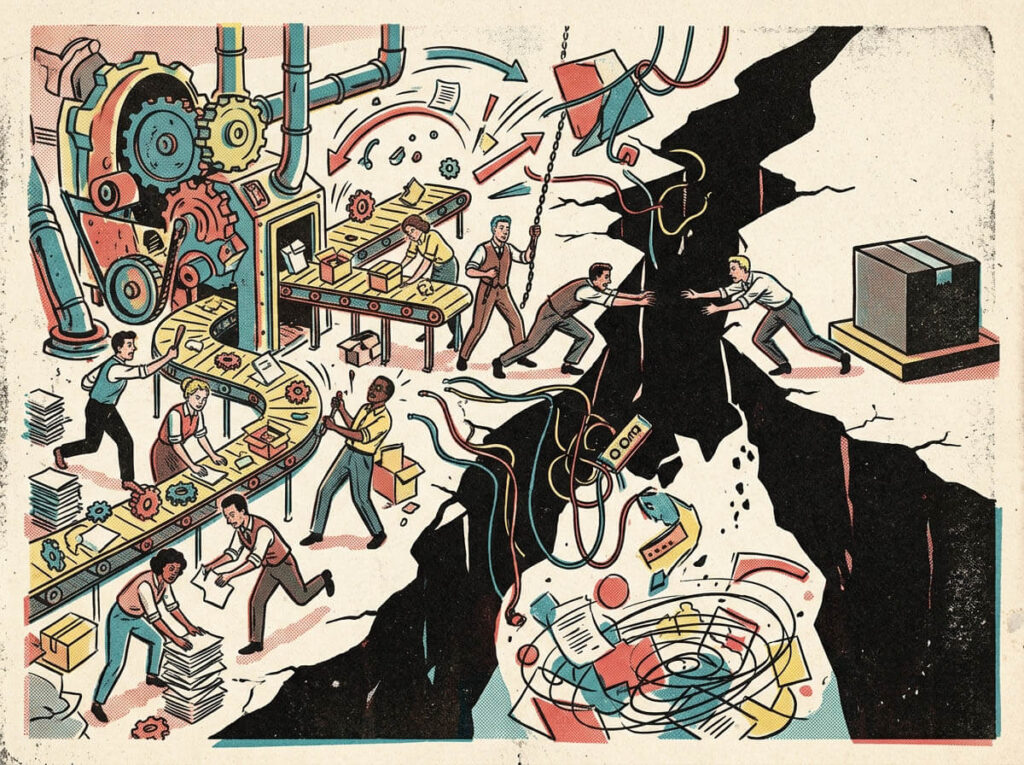
The Workflow Gap — Why Your Teams Feel “Busy” but Output Isn’t Moving
Most operationally inefficient companies do not look inefficient from the inside.
Calendars are full. Slack channels are active. Managers are responding at midnight. Teams are constantly “working on things.” Yet projects stall, customer issues repeat, delivery timelines slip, and profitability quietly erodes quarter after quarter.
This is the modern workflow gap.
Not a labor shortage.
Not usually a talent problem.
Not even primarily a technology problem.
An architectural problem.
The most dangerous operational inefficiencies today are not visible as downtime. They appear as motion. The organization looks active while throughput declines underneath it.
In manufacturing, this shows up as planners spending more time reconciling spreadsheets than improving production flow. In logistics, dispatch teams drown in coordination overhead while route efficiency stagnates. In healthcare operations, staff spend entire shifts navigating fragmented systems instead of moving patients through care pathways. In construction, project managers become human middleware between disconnected tools, subcontractors, and reporting structures.
The organization becomes increasingly optimized around coordination rather than execution.
That distinction matters more than most leaders realize.
Research consistently shows knowledge workers now spend roughly 60% of their time on “work about work” — status updates, searching for information, tool switching, internal coordination, duplicate entry, meetings, and administrative maintenance rather than actual value creation.
The economic consequence is severe because coordination scales non-linearly. As organizations grow, unmanaged workflow complexity compounds faster than headcount or revenue. Eventually the business reaches a point where adding people increases communication load more than productive capacity.
That is when teams begin feeling permanently busy while output plateaus.
And most SMEs reach this point long before they realize they have crossed it.
The Problem Is Misdiagnosed Because Activity Is Easier to See Than Flow
Most operators still evaluate productivity using industrial-era instincts.
Who is responsive?
Who looks overloaded?
Who attends meetings?
Who closes the most tickets?
Who is visibly active?
These are activity metrics masquerading as productivity metrics.
The problem is that modern operational work is increasingly cognitive, cross-functional, and systems-dependent. In those environments, visible effort often inversely correlates with leverage.
The busiest teams are frequently compensating for broken workflow architecture.
This creates a dangerous management illusion.
Leaders observe:
- more messages,
- more meetings,
- more reporting,
- more software,
- more dashboards,
- more escalation,
- more urgency,
…and interpret those signals as operational intensity.
In reality, they are often signals of workflow fragmentation.
Harvard Business Review’s “toggle tax” research quantified workers switching applications roughly 1,200 times per day, losing nearly four hours weekly simply reorienting between systems.
That statistic understates the real damage because the true loss is not minutes.
It is cognitive continuity.
A planner switching between ERP records, spreadsheets, emails, WhatsApp groups, PDFs, and project management systems does not merely lose time. They lose synthesis. The mental model resets repeatedly. Complex operational reasoning becomes impossible under continuous interruption.
This is why many organizations experience a paradoxical combination of:
- constant urgency,
- declining strategic clarity,
- slower execution,
- increasing managerial dependence,
- and worsening decision quality.
The business becomes operationally reactive.
And reactive organizations mistake motion for progress.
Workflow Failure Happens at the Hand-Off Layer
Most companies assume operational problems originate inside departments.
Usually they originate between them.
The workflow gap lives in hand-offs.
Between sales and operations.
Between operations and finance.
Between procurement and delivery.
Between field teams and headquarters.
Between customer service and fulfillment.
Between estimators and project managers.
This is where work disappears.
Not physically. Informationally.
Ownership becomes ambiguous. Data fragments across tools. Verbal decisions never enter systems. Status changes exist in chats but not records. Teams maintain shadow workflows because official systems cannot support actual operational reality.
The result is organizational drift.
No single system reflects the truth about:
- priorities,
- workflow state,
- bottlenecks,
- accountability,
- exceptions,
- or downstream impact.
This is why many SMEs feel operationally exhausted despite reasonable demand conditions.
The organization spends increasing energy compensating for coordination gaps instead of improving throughput.
A logistics company may add dispatchers while route planning inefficiencies remain unresolved. A construction firm may hire more project coordinators while subcontractor communication remains structurally fragmented. A healthcare group may increase administrative staffing while patient flow systems remain disconnected.
Headcount rises. Output barely moves.
Because the constraint was architectural, not labor-based.
The Most Dangerous Workflow Problems Are Informal Ones
Operationally inefficient SMEs rarely collapse because of a single catastrophic system failure.
They decay through normalization of workaround behavior.
That is the real pattern.
Teams build operational survival systems around broken infrastructure:
- spreadsheet overlays,
- duplicate data entry,
- personal trackers,
- undocumented approvals,
- side-channel communication,
- shadow CRMs,
- manual reconciliations,
- WhatsApp coordination groups,
- tribal knowledge dependencies.
Initially these workarounds appear productive because they restore short-term throughput.
Over time they become organizational debt.
The business starts depending on individuals instead of systems.
That creates four compounding risks:
- Scalability failure: Workflows only function through heroic effort.
- Institutional fragility: Key employees become irreplaceable because process logic exists inside their heads.
- Decision latency: Managers spend increasing time reconciling conflicting information.
- Margin erosion: Operational inefficiency silently increases cost-to-deliver.
This last point is massively underestimated in SMEs.
Many established businesses assume margin compression is a pricing or market problem when the underlying issue is operational drag embedded across hundreds of small workflow inefficiencies.
The business leaks profitability through friction.
Not through demand collapse.
Tool Proliferation Usually Makes the Problem Worse
One of the worst modern operating assumptions is that productivity problems are solved by adding software.
Most companies already have too many tools.
What they lack is workflow coherence.
This distinction matters because disconnected systems increase coordination load.
Every additional platform creates:
- another interface,
- another notification stream,
- another authentication layer,
- another data model,
- another source of truth conflict,
- another context switch,
- another integration requirement.
Without workflow architecture, technology compounds complexity rather than reducing it.
This is why many organizations experience what researchers now call the productivity paradox:
more digital tools, less operational clarity.
The pattern is extremely common in SMEs.
A business accumulates:
- CRM software,
- project management platforms,
- ERP systems,
- messaging apps,
- reporting dashboards,
- scheduling systems,
- AI assistants,
- automation tools,
yet core operational workflows still rely on manual coordination.
The stack grows faster than operational integration maturity.
Eventually employees become full-time translators between systems.
At that point, software has stopped functioning as infrastructure and started functioning as operational overhead.
High-Performing Operators Optimize for Flow, Not Utilization
This is where most operational thinking breaks down.
Traditional management optimizes for resource efficiency:
- keep everyone busy,
- maximize utilization,
- fill calendars,
- minimize idle time.
But high-utilization systems often produce terrible flow.
Manufacturing learned this decades ago. Knowledge work largely has not.
If every person is overloaded, work queues expand everywhere:
- approvals wait,
- decisions stall,
- priorities collide,
- interruptions multiply,
- multitasking increases,
- cycle times expand.
The organization looks fully utilized while throughput deteriorates.
Sophisticated operators optimize for flow efficiency instead:
- reduced work-in-progress,
- fewer active priorities,
- cleaner hand-offs,
- lower coordination overhead,
- uninterrupted execution windows,
- clearer systems of record.
This feels counterintuitive to many leaders because flow-oriented organizations often appear calmer.
Less frantic communication.
Fewer meetings.
Less escalation.
More asymmetrical output.
That calmness is usually operational maturity, not underperformance.
The Companies Pulling Ahead Are Protecting Cognitive Capacity
The next competitive divide will not simply be AI adoption.
It will be cognitive architecture.
Organizations that systematically protect high-value thinking capacity will outperform those that consume it through operational noise.
This is already visible.
The strongest operators increasingly:
- consolidate systems,
- reduce unnecessary coordination,
- standardize workflow interfaces,
- automate administrative movement,
- minimize context switching,
- and reserve human cognition for judgment-heavy work.
They understand something most companies still miss:
Deep work capacity is now a scarce operational resource.
And most organizations waste it aggressively.
When senior staff spend entire days:
- reconciling updates,
- chasing approvals,
- attending status meetings,
- manually transferring information,
- responding reactively,
- or searching for data,
the business loses its highest-leverage capability:
structured problem solving.
This matters especially in operationally intensive SMEs where complexity already compounds naturally through:
- locations,
- vendors,
- crews,
- inventory,
- schedules,
- regulations,
- customer variability,
- and legacy systems.
Without deliberate workflow architecture, operational entropy eventually overwhelms management capacity.
A Practical Framework for Diagnosing the Workflow Gap
Most companies attempt workflow improvement too tactically.
They automate isolated tasks instead of redesigning operational flow.
A more effective approach starts with five questions.
- Where does work actually wait?
Not where people complain.
Where cycle time accumulates.
Map:
- approval delays,
- rework loops,
- queue buildup,
- dependency bottlenecks,
- information retrieval delays.
This exposes true operational constraints.
- Where are humans acting as system connectors?
Identify roles spending significant time:
- transferring data,
- reconciling systems,
- chasing updates,
- manually routing work,
- interpreting fragmented information.
These are architectural failures disguised as jobs.
- Which workflows lack a system of record?
If workflow truth exists primarily in:
- meetings,
- chats,
- spreadsheets,
- memory,
- or email,
the process is structurally unstable.
- Which metrics reward activity instead of outcomes?
This is one of the largest hidden drivers of workflow dysfunction.
If teams are measured on:
- responsiveness,
- task volume,
- hours,
- message activity,
- utilization,
they will optimize for visible motion instead of business leverage.
- Where is high-skill labor performing low-leverage work?
This is often the largest economic inefficiency.
Operations managers doing data cleanup.
Project leaders chasing approvals.
Executives consolidating reports manually.
High-value staff should spend maximal time:
- solving exceptions,
- improving systems,
- making decisions,
- strengthening workflows,
- increasing throughput.
Not maintaining operational fragmentation.
The Trade-Offs Are Real — and Usually Mishandled
There is a tendency in digital transformation conversations to frame workflow optimization as universally positive.
It is not.
Poorly executed standardization creates brittle systems.
Over-automation reduces adaptability.
Aggressive process compression can damage compliance, safety, or customer experience.
This matters in industries like:
- healthcare,
- construction,
- logistics,
- regulated operations,
- and multi-location service businesses.
The goal is not eliminating all friction.
The goal is eliminating low-value friction.
That distinction matters enormously.
Good workflow architecture preserves:
- necessary judgment,
- exception handling,
- operational flexibility,
- local adaptability.
Bad workflow architecture removes resilience in pursuit of efficiency metrics.
This is why operational redesign cannot be treated as a software deployment exercise.
It requires systems thinking.
AI Will Magnify Workflow Quality — Not Replace It
A major misconception in the current market is that AI itself creates operational advantage.
It does not.
AI amplifies the quality of the surrounding system.
Inside fragmented operations, AI often increases noise:
- more interfaces,
- more outputs,
- more decisions,
- more disconnected information.
Inside integrated workflows, AI becomes multiplicative.
It can:
- summarize operational states,
- route requests,
- identify bottlenecks,
- automate low-value coordination,
- surface exceptions,
- reduce search time,
- accelerate decisions,
- and compress administrative overhead.
But only if embedded into coherent operational infrastructure.
Otherwise AI simply becomes another tool employees must manage.
This is why infrastructure-oriented firms increasingly approach automation differently than traditional agencies or software vendors.
The strongest implementations do not start with “Where can we use AI?”
They start with:
- “Where does workflow break?”
- “Where does coordination consume disproportionate energy?”
- “Where is cognitive load unnecessarily high?”
- “Where are decisions delayed because systems are fragmented?”
Only then does automation become strategically useful.
That distinction separates operational transformation from software accumulation.
The Strategic Reframing Most SMEs Need
When teams feel permanently busy but output stagnates, leaders often default to:
- hiring,
- restructuring,
- accountability pressure,
- productivity initiatives,
- or additional software.
Those interventions occasionally help temporarily.
But they rarely solve the core issue because the problem usually sits beneath the org chart.
Inside the workflow layer.
That is the reframing many established SMEs need to make.
Operational competitiveness is no longer determined solely by:
- labor quality,
- market demand,
- or management effort.
It is increasingly determined by how effectively the business converts organizational attention into value-producing flow.
The companies gaining structural advantage are not merely working harder.
They are reducing operational drag faster than competitors.
They are building systems where:
- information moves cleanly,
- decisions surface quickly,
- workflows are visible,
- tools are integrated,
- hand-offs are engineered,
- and high-value cognition is protected.
That is not a productivity hack.
It is infrastructure strategy.
And over the next decade, it will likely become one of the clearest dividing lines between SMEs that scale operationally and those that remain permanently trapped in coordinated chaos.