


Your Marketing Agency Probably Didn’t Fail. Your Revenue System Did.
The uncomfortable reality in most operationally intensive SMEs is that marketing is usually blamed for revenue stagnation because it is the most visible moving part in the system.
Revenue problems are rarely visible.
What leadership sees is the agency retainer, the ad spend, the redesigned website, the SEO reports, the campaign dashboards, and the monthly meetings explaining why impressions are rising while revenue remains flat.
What leadership does not see is the lead sitting untouched in a sales rep’s inbox for four days. The estimator manually retyping form submissions into a spreadsheet. The operations manager quietly rejecting higher-volume projects because fulfillment is already overloaded. The CRM that technically exists but is ignored by half the company. The pricing model that rewards low-margin work while marketing attracts more of it.
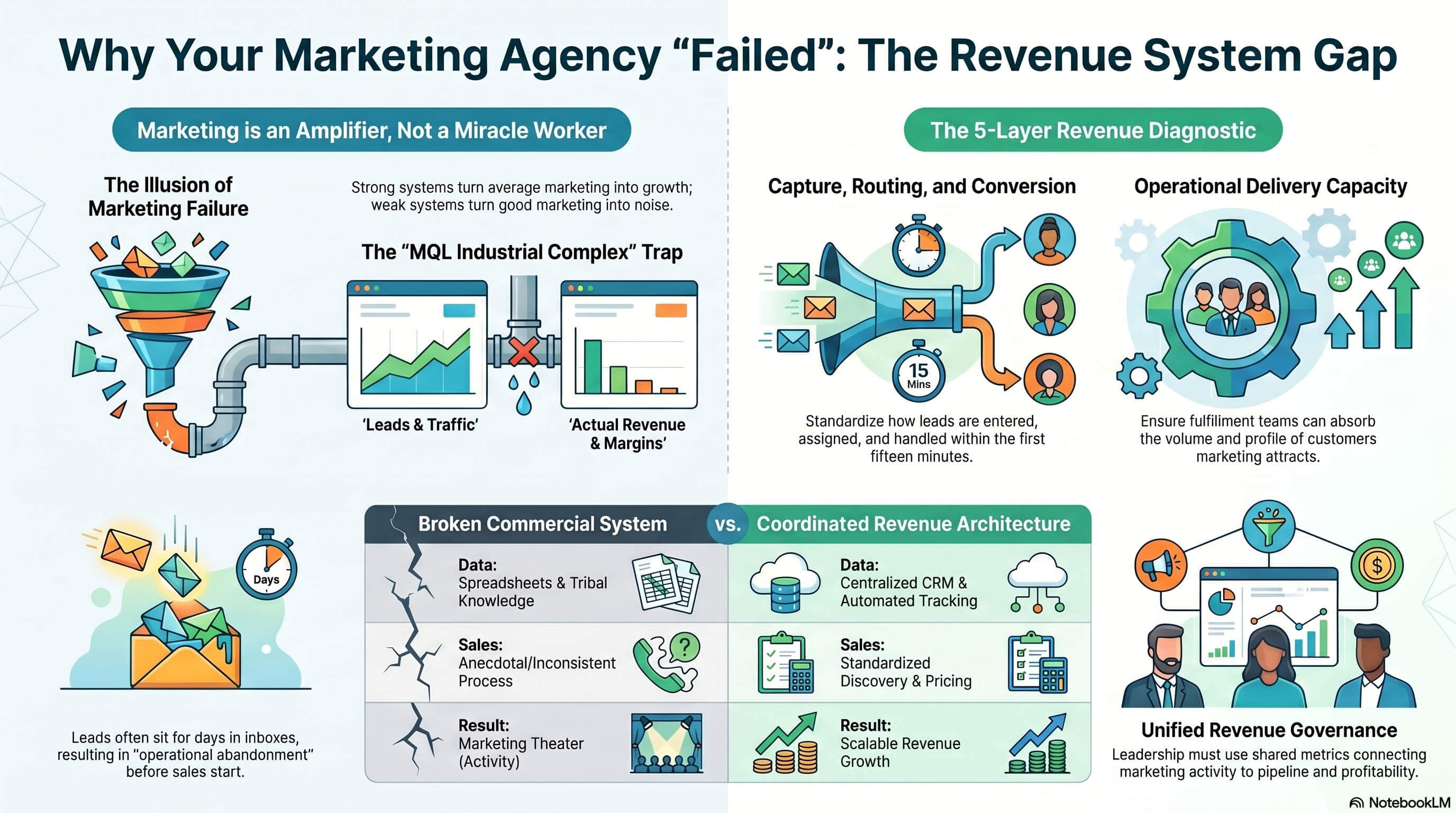
In manufacturing, logistics, construction, healthcare operations, and multi-location service businesses, marketing does not operate independently. It amplifies the commercial infrastructure already underneath it.
That amplification cuts both ways.
A strong revenue system turns average marketing into growth.
A weak revenue system turns good marketing into noise.
After fifteen years watching companies cycle through agencies, the pattern is painfully consistent: the first agency gets blamed for lead quality, the second for strategy, the third for execution, and eventually leadership concludes that “marketing doesn’t work in our industry.”
Usually the business never diagnosed the actual constraint.
And in many cases, the agency was generating demand the company simply could not operationally convert.
The Industry Trained Companies to Measure the Wrong Thing
Most SMEs buy marketing the same way they buy outsourced production capacity.
They define deliverables.
Run ads.
Redesign the website.
Improve SEO.
Generate leads.
Post content.
Then they expect revenue to emerge downstream.
This framing is structurally flawed because revenue is not produced by marketing activity alone. Revenue emerges from the coordination between demand generation, sales conversion, operational capacity, pricing architecture, delivery quality, retention, and financial discipline.
Yet most agencies are commercially incentivized to isolate marketing from the rest of the system because it narrows accountability.
The result is what many operators privately call the MQL industrial complex.
Dashboards stay green.
Traffic rises.
Lead volume rises.
Cost per click improves.
Engagement improves.
But pipeline quality deteriorates, margins compress, sales teams distrust marketing, and operations becomes overloaded with poorly qualified work.
This is why executives often feel like agencies are simultaneously active and ineffective.
Both perceptions are true.
The agency may genuinely be improving channel performance while the business itself lacks the infrastructure required to convert that activity into profitable revenue.
One of the more dangerous pieces of modern business advice is the claim that “you just need more leads.”
Operationally intensive businesses almost never have a pure lead shortage problem.
They usually have one of five deeper problems:
- Lead handling failures
- Sales process inconsistency
- Weak positioning
- Operational bottlenecks
- Poor economic filtering of opportunities
More leads poured into a broken commercial system do not create growth.
They create waste at higher velocity.
Research repeatedly shows that a large percentage of inbound leads are either never contacted or contacted far too slowly to convert effectively. In many firms, response times are measured in days instead of minutes. That means companies often pay agencies to generate opportunities they operationally abandon before the sales process even starts.
The agency gets blamed because the leak is downstream and invisible.
Marketing Performance Is Capped by the Weakest Operational Layer
This is the part most companies never model correctly.
Marketing is not a department.
In practice, marketing is an input mechanism into a larger revenue operating system.
The performance ceiling of that system is determined by its weakest constraint.
If your sales process is inconsistent, marketing scales inconsistency.
If your quoting process is slow, marketing scales delays.
If your operations team is overloaded, marketing scales delivery failures.
If your CRM is fragmented, marketing scales data corruption.
This is why some companies double marketing spend and see almost no revenue movement while others produce meaningful growth with relatively average campaigns.
The difference is usually not creative quality.
It is systems maturity.
One industrial manufacturer generated substantial inbound demand through SEO and paid acquisition after years of relying almost entirely on referrals. The campaigns worked. Qualified leads increased significantly.
But the revenue impact only materialized after the company aligned sales handling, messaging, and operational workflows around the new demand flow.
Without that alignment, inbound volume alone would have simply produced administrative chaos.
Another manufacturing business improved lead volume dramatically through digital strategy and technical content development, but one of the biggest gains came from optimizing RFQ workflows and shortening the sales cycle operationally.
That distinction matters.
Marketing did not independently create the growth.
The coordinated redesign of the commercial process did.
The companies that consistently extract ROI from agencies usually treat marketing as one layer inside a broader operating architecture.
The companies that consistently fail tend to isolate marketing as a standalone function while everything around it remains fragmented.
The Real Revenue Leak Usually Happens After the Lead Arrives
Most executives overestimate the sophistication of their commercial operations.
A company can be doing $10M–$50M annually and still run mission-critical revenue workflows through inboxes, spreadsheets, tribal knowledge, and undocumented processes.
From the outside, the business looks established.
Internally, the system is brittle.
The highest-value diagnostic question is rarely:
“Is the agency generating leads?”
The better question is:
“What happens operationally within the first fifteen minutes after a lead enters the business?”
That single question exposes most revenue problems.
In many SMEs, nobody can answer it clearly.
Leads sit in generic inboxes.
Forms fail to sync with CRM systems.
Sales ownership is ambiguous.
Follow-up standards do not exist.
Lead qualification criteria differ between departments.
Proposal quality varies by salesperson.
Operations teams are excluded from campaign planning.
Then leadership wonders why revenue stays flat.
One of the more revealing patterns across operational businesses is that sales teams often reject leads as “bad” when the real issue is that the company lacks a standardized conversion process.
If every salesperson runs discovery differently, qualifies differently, prices differently, and follows up differently, then lead quality becomes impossible to measure objectively.
The business starts optimizing around anecdotal opinions instead of system data.
Marketing says the leads are good.
Sales says the leads are bad.
Operations says the customers are difficult.
Finance says margins are deteriorating.
Everyone is locally correct.
The system itself is misaligned.
This is why strong operators increasingly think in terms of revenue systems instead of marketing departments.
The moment marketing, sales, operations, delivery, and technology are treated as isolated functions, the business creates competing incentives.
Marketing optimizes for volume.
Sales optimizes for closed deals.
Operations optimizes for utilization.
Finance optimizes for margin.
Without shared metrics, every department improves its own dashboard while enterprise performance stagnates.
Why Agencies Often Look Competent but Still Fail Commercially
This is where the conversation becomes uncomfortable for both clients and agencies.
Many agencies are not fraudulent.
They are simply solving a narrower problem than the client thinks they hired them to solve.
An agency might genuinely improve:
- Traffic quality
- Search visibility
- Ad performance
- Content output
- Conversion rates on landing pages
- Brand perception
And still fail to materially impact revenue.
Not because those activities lack value, but because they represent only one segment of the commercial chain.
Operational businesses routinely expect agencies to compensate for failures they neither control nor scoped responsibility for.
For example:
An agency generates more inbound demand.
Sales response remains inconsistent.
Quoting takes twelve days.
Pricing lacks differentiation.
Operations misses delivery timelines.
Customer onboarding is fragmented.
Retention suffers.
The agency becomes the symbolic failure point because it is the newest variable in the system.
This creates a dangerous cycle where companies repeatedly switch vendors without ever upgrading the underlying architecture.
After enough failed engagements, leadership develops institutional cynicism toward marketing entirely.
Ironically, some of the strongest revenue transformations happen after businesses stop asking agencies to “do marketing” and instead ask:
“How does the entire commercial system actually produce revenue?”
That shift changes everything.
The Companies That Break Through Usually Rebuild Coordination First
The best-performing operational SMEs rarely look glamorous from the outside.
They look coordinated.
That distinction matters.
Their CRM is clean.
Lead routing is automated.
Sales ownership is clear.
Operational capacity is visible.
Pricing logic is standardized.
Marketing messaging reflects delivery realities.
Data definitions are shared.
Most importantly, leadership understands where revenue actually leaks.
A B2B training company that had spread execution across freelancers, disconnected websites, and fragmented vendors eventually consolidated its ecosystem into a centralized structure with clearer governance and fewer overlapping responsibilities.
Revenue improved.
Cost per lead improved.
Operational complexity decreased.
The improvement was not caused by discovering a magical marketing tactic.
It came from reducing fragmentation.
That pattern appears constantly.
Another technology company significantly increased marketing ROI not primarily through more campaigns, but through improved attribution, better audience optimization, and tighter system coordination.
Again, the leverage came from operational clarity.
Not content volume.
Not social posting frequency.
Not marketing theater.
This is also why vendor sprawl quietly destroys many SMEs.
One freelancer runs ads.
Another handles SEO.
A different agency manages branding.
An internal admin updates the CRM.
Sales tracks deals separately.
Operations works entirely outside the commercial workflow.
Nobody owns the full system.
Which means nobody can accurately diagnose performance.
The business accumulates activity without accumulating intelligence.
Most Revenue Problems Are Actually Governance Problems
This is the deeper layer most companies resist confronting.
A surprising number of “marketing failures” are really executive management failures.
Leadership teams often lack:
- Unified commercial metrics
- Defined operational SLAs
- Clear ICP economics
- Capacity visibility
- Process accountability
- Revenue ownership structure
So the company defaults to externalizing responsibility.
Hire another agency.
Buy another platform.
Install another AI tool.
Launch another campaign.
Technology and agencies become substitutes for operational discipline.
This is one reason AI implementation is currently being misunderstood across SMEs.
Businesses assume AI will fix growth inefficiencies automatically.
In reality, AI tends to amplify existing operational conditions.
If your workflows are fragmented, AI scales fragmentation.
If your data quality is poor, AI accelerates bad decisions.
If your lead management process is inconsistent, AI automates inconsistency.
The companies seeing meaningful gains from AI are usually not the ones buying the most tools.
They are the ones integrating automation into coherent operating systems.
That difference is strategic.
There is also an important trade-off many executives fail to appreciate.
Operational businesses often want immediate lead generation while simultaneously competing in markets that require long-cycle trust building.
Those objectives can conflict.
Industrial buyers, healthcare operators, logistics partners, and enterprise procurement teams rarely convert based on aggressive short-term tactics alone.
They buy credibility.
Technical depth.
Reliability.
Risk reduction.
Operational competence.
That means some marketing investments compound slowly.
Executives conditioned by direct-response internet marketing frequently misdiagnose this delayed effect as agency underperformance.
Sometimes the agency is ineffective.
But sometimes leadership expects enterprise-level buying behavior to respond like consumer ecommerce.
Those are different systems entirely.
A Better Diagnostic Framework for Agency Failure
When a business says, “Our marketing agency failed,” I generally evaluate five layers before blaming the agency itself.
1. Demand Quality
Was the agency targeting the correct ICP with economically viable positioning?
Not just whether leads were generated, but whether the campaigns attracted the type of customer the business can profitably serve.
Many agencies optimize for conversion volume while ignoring operational fit.
That creates growth with weak margins.
2. Capture and Routing
Did every lead reliably enter the system with automated ownership, tracking, and response standards?
This is where many SMEs quietly collapse.
If the business cannot contact inbound opportunities rapidly and consistently, marketing ROI becomes mathematically constrained.
3. Conversion Infrastructure
Did sales have standardized discovery, proposal, pricing, and follow-up systems aligned with the marketing promise?
A weak sales process destroys attribution clarity because outcomes vary by individual salesperson instead of system quality.
4. Delivery Capacity
Could operations actually absorb the volume and customer profile marketing was creating?
Strong campaigns routinely expose operational fragility.
Some businesses mistake operational overload for marketing success.
Others mistake operational failure for marketing failure.
Both interpretations are incomplete.
5. Governance and Measurement
Did leadership have a unified revenue view connecting marketing activity to pipeline, profitability, operational strain, and retention?
If every department operates from different numbers, the company cannot diagnose performance accurately.
Without shared visibility, blame replaces analysis.
This framework changes the conversation from:
“Did the agency work?”
to:
“Where is the actual commercial constraint?”
That is a much more useful question.
The Strategic Shift Operational SMEs Need to Make
Operationally intensive businesses are entering a period where fragmented execution is becoming economically expensive.
The old model of separate agencies, isolated software tools, disconnected CRMs, manual workflows, and departmental silos increasingly creates negative compounding effects.
Margins shrink.
Execution slows.
Data quality deteriorates.
Customer experience fragments.
Leadership loses visibility.
Then growth stalls.
The companies that outperform over the next decade will likely not be the ones with the loudest marketing.
They will be the ones with the strongest integration between brand, systems, automation, operations, and commercial execution.
That requires a fundamentally different mindset.
Not:
“How do we get more leads?”
But:
“How does our entire revenue ecosystem function under scale?”
That question changes vendor selection.
It changes technology strategy.
It changes operational design.
It changes KPI structures.
It changes leadership behavior.
It also explains why many traditional agencies struggle in operationally intensive sectors.
Most agencies are built around channel execution.
Very few are designed to diagnose revenue architecture.
There is a meaningful difference between generating attention and engineering scalable commercial systems.
The second problem is harder.
But it is also where the majority of enterprise value now sits.
The Real Reframe
If your marketing agency failed to increase revenue, the instinctive conclusion is usually:
“We hired the wrong agency.”
Sometimes that is true.
But after enough years inside operational businesses, the more accurate conclusion is usually:
“You asked marketing to solve a systems problem.”
That distinction matters because it changes where leverage exists.
Marketing can accelerate growth.
It cannot independently create operational maturity.
It cannot repair fragmented sales processes.
It cannot fix poor governance.
It cannot compensate indefinitely for weak delivery infrastructure.
And it certainly cannot produce predictable profitability inside a disconnected commercial ecosystem.
The businesses that eventually break through stop viewing marketing as a standalone growth function.
They start treating revenue generation as an integrated operating system.
That is the point where agencies stop being expensive experiments and start becoming force multipliers.
Not because the campaigns suddenly became brilliant.
But because the business finally became structurally capable of converting demand into scalable revenue.